(2,604)
A fully charged 12 V lead-acid battery at rest reads about 12.6 V or slightly more. Around 12.2 V corresponds to roughly half charge, and 12.0 V or less means the battery is effectively discharged. With the engine running, a healthy charging system shows roughly 13.8 to 14.4 V at the battery. A resting voltage test does not reveal lost capacity; that needs a load or conductance test.
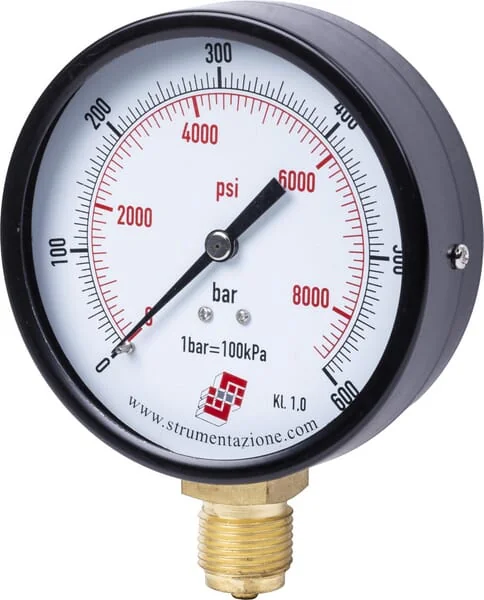
Many tractor hydraulic systems work at around 180 to 210 bar, so a gauge reading to 400 bar covers them with a safety margin and keeps the reading in the accurate part of the scale. Low-pressure circuits such as transmission lubrication or pilot pressure need a separate low-range gauge to be read accurately. The machine's test specifications give the expected values and test points.
Usually not. Passenger car scanners expect the 16-pin OBD connector and the emissions protocols used on road vehicles. Tractors and construction machines mostly communicate over SAE J1939 through a round diagnostic connector, and manufacturers add their own proprietary data. A diagnostic system needs both the right adapter cable and software coverage for the specific make and model.

Zeca - V27041 - Zeca Injector Tester Gauge 400 Bar
Zeca
€438.39
Showing 1–48 of 2,604 parts
With the battery disconnected or the system powered down, the resistance between the CAN high and CAN low wires should be about 60 ohms, because the bus has a 120 ohm terminating resistor at each end. A reading near 120 ohms means one terminator or part of the bus is missing, and a very low reading points to a short between the wires. Signal faults beyond that require an oscilloscope.
A compression test measures the peak pressure a cylinder builds while the engine is cranked, which shows whether a cylinder is weak compared with the others. A leak-down test feeds compressed air into the cylinder at top dead centre and measures how much escapes, and where the air comes out shows the cause: intake, exhaust, crankcase or coolant. The two tests are complementary.
The measurement category, defined in IEC 61010, describes the electrical environment a meter can safely be used in, from CAT II for plug-in equipment to CAT III for fixed building installations and CAT IV for the supply origin. Each category is paired with a voltage, such as CAT III 600 V. Low-voltage vehicle work is undemanding, but mains equipment and high-voltage electric drives need an appropriately rated meter and leads.
A workshop refractometer measures how strongly a liquid bends light, which changes with concentration. With the appropriate scales it reads the frost protection of coolant, the charge state of battery acid, and the concentration of AdBlue, which should be 32.5 % urea. Only a few drops are needed. The instrument has to carry the scale for the liquid being tested, since glycol types read differently.